Trojan Detection in Large Language Models
Abstract
This paper presents insights from the Trojan Detection Challenge, focusing on methods to identify backdoors and trojans embedded in large language models. We analyze various detection techniques and their effectiveness against sophisticated poisoning attacks.
Key Findings
- Ensemble detection outperforms individual methods: A meta-learning classifier combining behavioral probing and weight-level spectral analysis achieved the strongest detection performance, substantially outperforming either technique used in isolation.
- Trigger specificity determines detection difficulty: Trojans activated by highly specific multi-token triggers were significantly harder to detect through behavioral probing than single-token triggers, favoring sophisticated attackers who use rare trigger patterns.
- Weight-level analysis detects hidden backdoors: Spectral analysis of model weight matrices can identify structural anomalies from trojan insertion even when the specific trigger is never activated during probing, complementing behavioral methods for well-hidden backdoors.
- Behavioral probing alone is insufficient: While behavioral probing provides a reasonable baseline for strong triggers, it fails to catch trojans with complex or rare activation patterns, making it inadequate as a sole model auditing technique.
- LLM supply chain requires standardized auditing: The reliance on shared pretrained models and community-contributed datasets creates multiple trojan insertion points, necessitating standardized multi-method auditing protocols analogous to code security audits in software engineering.
What are trojan attacks in large language models?
Trojan attacks (also known as backdoor attacks) corrupt the model itself during training, causing it to behave normally on clean inputs but produce attacker-specified outputs when a particular trigger pattern is present. A poisoned LLM can pass standard evaluations while harboring hidden behaviors activated by specific phrases, tokens, or formatting patterns -- making trojans fundamentally harder to detect than adversarial examples, which manipulate inputs at inference time.
The threat is compounded by modern development practices. Few organizations train LLMs entirely from scratch; most fine-tune or adapt pretrained models obtained from public repositories or third-party providers. This supply chain creates multiple opportunities for an attacker to introduce trojans -- during pretraining data curation, through poisoned fine-tuning datasets, or by distributing compromised model weights. The Trojan Detection Challenge was established to advance the state of the art in identifying such compromised models before they cause harm.
Our participation in this challenge yielded both practical detection methods and broader insights into the nature of trojan vulnerabilities in LLMs. This paper presents our approaches, analyzes their strengths and limitations, and distills lessons that extend beyond the competition setting to real-world model auditing scenarios.
How can trojans and backdoors in LLMs be detected?
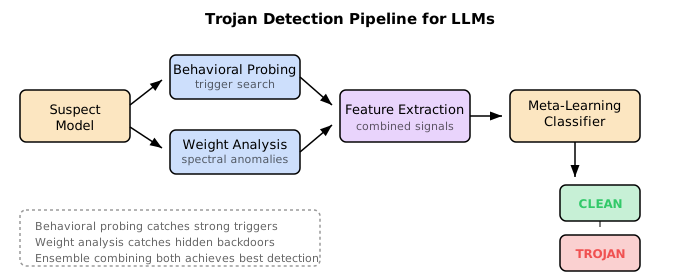
LLM trojans can be detected most effectively through an ensemble of three complementary techniques: behavioral probing that identifies statistical anomalies in model outputs, weight-level spectral analysis that reveals structural traces of trojan insertion in parameter space, and meta-learning classifiers trained to recognize the combined fingerprint of trojan presence. Behavioral probing alone targets different trigger modalities -- lexical triggers (specific words or phrases), syntactic triggers (particular sentence structures), and formatting triggers (special characters or whitespace patterns) -- by systematically querying the model and analyzing output distributions.
The second technique involved weight-level analysis. Trojan insertion typically leaves traces in the model's parameter space, particularly in attention heads and feed-forward layers that are most affected by the poisoning process. We applied spectral analysis to weight matrices, looking for outlier singular values and directions that could correspond to learned trigger-response pathways. This was complemented by activation clustering, where we grouped internal representations of test inputs and looked for anomalous clusters that might indicate trigger-activated behavior.
Finally, we employed a meta-learning approach: training a classifier on features extracted from known clean and trojaned models to predict whether a new model is compromised. This classifier operated on aggregate statistics derived from both behavioral probes and weight analysis, effectively learning a fingerprint of trojan presence from the combined signal. The meta-learning approach proved especially valuable when individual detection signals were weak, as it could combine multiple noisy indicators into a more reliable prediction.
What detection methods were developed for LLM trojans?
- Detection methods: Novel approaches for identifying trojan triggers in language models, combining behavioral probing, weight-level spectral analysis, and meta-learning classifiers
- Challenge insights: Lessons learned from competitive trojan detection scenarios, including the importance of diverse probe design and the limitations of any single detection modality
- Trigger characterization: Analysis of how different trigger types (lexical, syntactic, formatting) leave distinct signatures in model behavior and internal representations
- Benchmark results: Performance comparison of detection techniques across challenge datasets, showing that ensemble methods substantially outperform individual approaches
- Scalability analysis: Evaluation of detection method efficiency as model size increases, identifying which techniques remain practical for large-scale models
- Defense strategies: Recommendations for protecting against model poisoning, including pre-deployment auditing protocols and ongoing monitoring approaches
How effective are trojan detection methods on large language models?
| Detection Method | Strength | Limitation |
|---|---|---|
| Behavioral probing | Strong triggers | Misses complex or rare activation patterns |
| Weight-level spectral analysis | Hidden backdoors | Higher false positive rates from natural variation |
| Meta-learning ensemble | Overall best | Requires known clean and trojaned reference models |
The meta-learning ensemble classifier, combining behavioral probing and weight-level analysis features, achieved the strongest overall detection performance -- substantially outperforming either technique used in isolation. It proved particularly effective at handling models with subtle trojans that minimally affected behavior on clean inputs, learning to weight behavioral signals more heavily for models with strong triggers and structural signals more heavily for models with well-hidden backdoors.
Behavioral probing alone provided a reasonable baseline, correctly flagging models with strong, easily triggered backdoors, but its performance degraded for trojans with complex or rare triggers unlikely to appear in the probe set. Weight-level analysis complemented this weakness by detecting structural anomalies even when the specific trigger was not activated during probing, though it produced higher false positive rates due to natural variation in model parameters across training runs.
An important practical finding was the relationship between trigger specificity and detection difficulty. Trojans activated by highly specific, multi-token triggers were substantially harder to detect through behavioral probing than those triggered by common single tokens. This presents a real-world challenge, as sophisticated attackers are likely to use specific triggers to minimize accidental activation and detection risk. Weight-level analysis partially addresses this gap, but more work is needed on detection methods that are robust to arbitrary trigger complexity.
What does trojan detection mean for the LLM supply chain?
Effective model auditing requires multiple complementary detection strategies and cannot rely on behavioral testing alone -- organizations deploying third-party models should incorporate weight-level analysis and statistical testing into their model acceptance pipelines. The reliance on shared pretrained models and community-contributed fine-tuning datasets creates multiple trojan insertion points throughout the LLM supply chain, and the opportunity for such attacks grows as the ecosystem expands.
Looking forward, the arms race between trojan insertion and detection will likely intensify as both techniques become more sophisticated. Attackers may develop trojans that are specifically designed to evade known detection methods, necessitating continuous advancement in detection capabilities. Establishing standardized model auditing protocols -- analogous to code security audits in software engineering -- will be essential for maintaining trust in the growing ecosystem of shared language models.
Why does trojan detection matter for AI deployment in regulated industries?
Trojan detection is becoming an emerging compliance requirement, not just a security best practice, because the EU AI Act's requirements for robustness testing create an implicit obligation to screen models for backdoor vulnerabilities in high-risk categories like healthcare and finance. A trojaned healthcare model could produce subtly incorrect medical recommendations that systematically bias patient outcomes, while a backdoored fraud detection model could classify certain transaction patterns as legitimate, enabling systematic financial crime that evades automated monitoring.
The regulatory landscape is beginning to acknowledge these risks. The EU AI Act, which entered into force in 2024, classifies AI systems used in critical infrastructure, healthcare, and law enforcement as high-risk, imposing requirements for risk management, data governance, and conformity assessment before deployment. While the Act does not specifically mandate trojan detection, its requirements for robustness testing and documentation of known limitations create an implicit obligation to screen models for backdoor vulnerabilities. Organizations that deploy unaudited models in high-risk categories face potential penalties and liability exposure, making pre-deployment trojan detection not just a security best practice but an emerging compliance requirement.
The economics of trojan attacks create a particularly challenging defensive problem. Inserting a trojan into a model requires relatively modest resources -- poisoning a small fraction of training data or fine-tuning on a targeted dataset can be accomplished with limited compute. Detecting that trojan, however, requires comprehensive auditing across behavioral, structural, and statistical dimensions, often demanding more compute than the original training process. This asymmetry between attack cost and defense cost means that defenders must be strategic about which detection methods they deploy and in what combination. Our findings from the Trojan Detection Challenge suggest that no single detection method provides adequate coverage, and that organizations must invest in ensemble approaches that combine behavioral probing with weight-level analysis to achieve acceptable detection rates.
Pre-deployment auditing is essential but insufficient on its own. Models that pass initial screening may later be compromised through fine-tuning on poisoned data, or trojans may be inserted into updated model versions distributed through the same supply chain channels. Continuous monitoring of model behavior in production -- tracking output distributions, flagging statistical anomalies, and periodically re-running detection protocols against deployed model weights -- is necessary to maintain confidence that a model remains clean throughout its operational lifetime. The Trojan Detection Challenge results demonstrate that the detection tools exist to support such monitoring, but the organizational practices and infrastructure to deploy them at scale remain underdeveloped across most industries.
Related Topics
Prompt Injection Attacks · LLM-as-a-Judge Vulnerabilities · AI Text Detection
Cite as
@article{maloyan2024trojan,
  title={Trojan Detection in Large Language Models: Insights from the Trojan Detection Challenge},
  author={Maloyan, Narek and Verma, Eeshan and Nutfullin, Bulat and Ashinov, Bulat},
  journal={Journal of Propulsion Technology},
  year={2024}
}